This Strategy outlines a focused approach to strengthening Australia’s capacity to translate health and medical research into improved health outcomes, stronger public policy, and a thriving knowledge economy. It reflects NHMRC’s leadership role in enabling research translation through targeted funding, capability building, and system-wide collaboration.
The complete Strategy is available in the download section below.
Publication Data
Table of contents
Key terms
| Term | Definition |
|---|---|
| Clinician | Healthcare practitioners who are involved in the provision of health and medical services and care, including diagnosis and/or treatment of patients, public and preventive medicine, and clinical research. This includes doctors, nurses, midwives, allied health and oral health professionals. |
| Commercialisation | The active processes by which the outcomes of research and development are brought to market as new or improved technologies, processes, products, or services that generate economic or social value. *Where research involves Aboriginal and Torres Strait Islander peoples, knowledge, data or biological materials, commercialisation must occur with appropriate community governance, informed consent, and mutually agreed benefit-sharing, consistent with cultural protocols. |
| Consumer | A broad term that refers to people with lived experience of a health issue and/or accessing health care and health systems. These include patients, potential patients, their families, friends, and carers. Consumers can also be people who represent the views and interests of a consumer organisation or patient.1 |
| Consumer and Community Involvement | When consumers and communities actively work with researchers and research institutions to shape decisions about priorities, policy, and practice related to health and medical research.1 |
| Development | The advancement of health and medical research findings into robust, applicable and scalable outputs, including methods, knowledge, technologies, tools, interventions, systems, and services, through refinement, testing, validation and maturation typically in compliance with quality systems to support readiness for translation or commercialisation. |
| End-user | Beneficiaries of NHMRC research including communities, consumers, policymakers, providers of healthcare and health-related systems, professionals, industry and philanthropy. |
| Industry | In the context of health and medical research translation and commercialisation, refers to the broad ecosystem of organisations — public, private, for-profit, not-for-profit and community-based — which acts as an enabler contributing the expertise, resources, infrastructure and pathways needed to move research into real-world products, processes, services and impact. *This includes Aboriginal and Torres Strait Islander community-controlled organisations and enterprises as active partners in creating pathways to impact. |
| Intellectual property | Intangible property resulting from intellectual activity in industrial, scientific, literary, or artistic fields. |
| Philanthropy | The giving of money, time, information, goods and services, influence and voice to improve the wellbeing of humanity and the community. |
| Policymaker | An individual or body responsible for or involved in establishing policy. For example: policymakers develop and implement health policies by using research evidence to inform decisions and translate findings into practice. |
| Priority populations | These include Aboriginal and Torres Strait Islander peoples, culturally and linguistically diverse people, LGBTIQ+ people, people with disability, people with mental health conditions, people in low socio-economic groups and people living in regional, rural and remote areas. |
| Research impact | The verifiable outcomes that research makes to knowledge, health, the economy and/or society. Impact is the effect of the research after it has been adopted, adapted for use, or used to inform further research. |
| Research institution | A university, independent research institute, hospital, or any organisation that conducts research. |
| Research translation | The process of moving research findings into practical application in real-world settings, and making research findings accessible and usable to practitioners, policymakers, community and the public to inform decision-making and improve health outcomes. Research translation can encompass dissemination of new clinical interventions and health guidelines, development and commercialisation of novel health and medical technologies, products, processes and services, and changes to policies and programs. *In Indigenous contexts, research translation should be guided by community priorities and culturally appropriate ways of creating, sharing, applying and sustaining knowledge. |
Introduction
The NHMRC Research Translation Strategy (the Strategy) is designed to advance NHMRC’s ambition of ‘Building a healthy Australia’. It outlines how NHMRC will drive the translation of health and medical research into public policy, health systems and clinical practice, while enabling the commercialisation of research discoveries within and beyond the health system. Through these efforts, the Strategy seeks to improve health outcomes for individuals and communities nationwide.
NHMRC’s three strategic themes – investment, translation and integrity – reflect its legislated functions: to fund health and medical research and training; to issue evidence-based guidelines that aim to improve health outcomes through better prevention, diagnosis and treatment; and to advise on ethical issues in health. These themes also reinforce NHMRC’s commitment to upholding the highest standards of ethics and integrity in health and medical research (Figure 1).
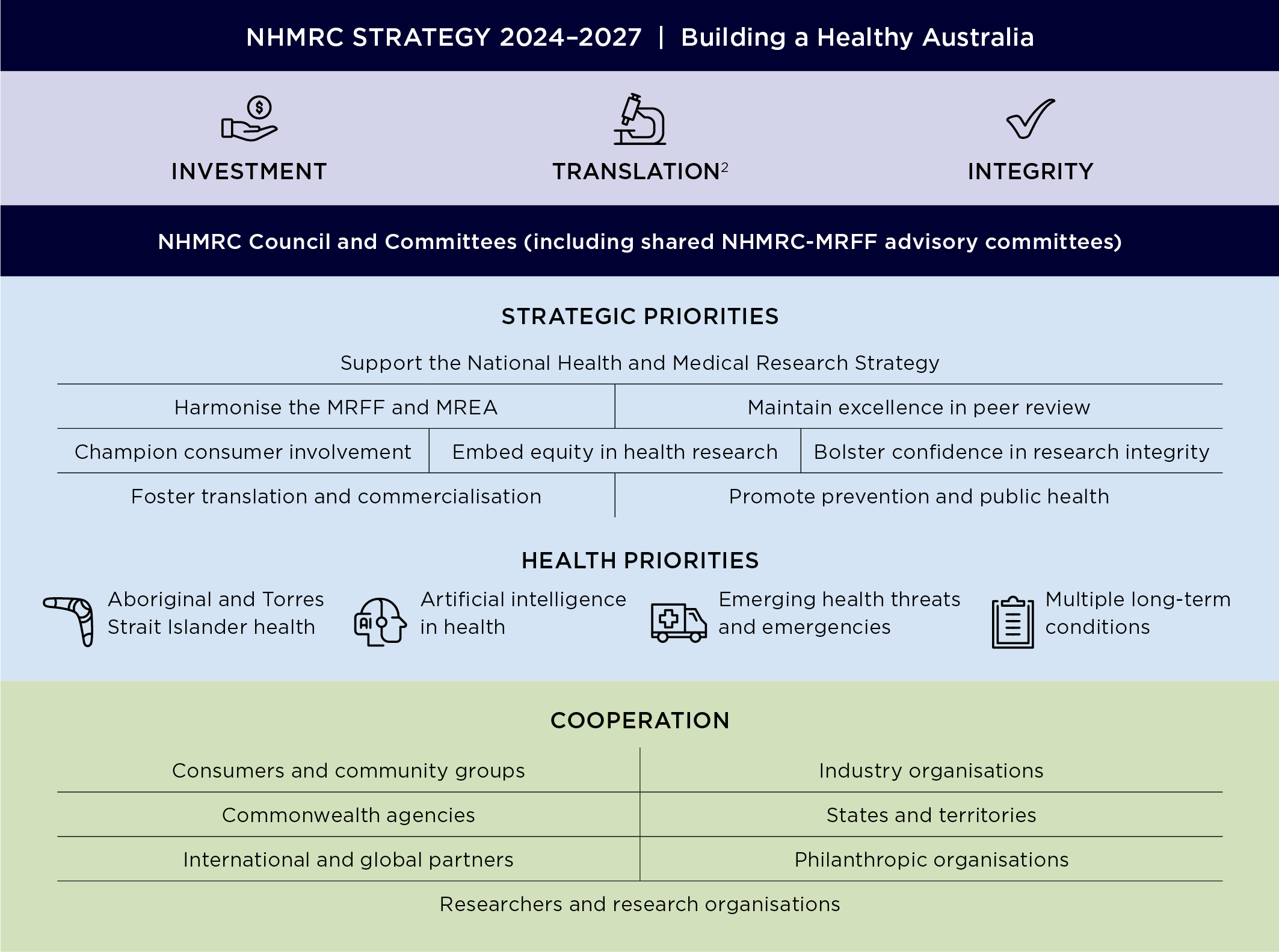
- Figure 1 image description
This infographic outlines the NHMRC Strategy 2024–2027 titled 'Building a Healthy Australia'
At the top are three core pillars: investment, translation and integrity. These are supported by NHMRC Council and committees, including shared NHMRC-MRFF advisory committees.
Across the centre is a dark band labelled NHMRC Council and Committees (including shared NHMRC–MRFF advisory committees).
The middle section outlines Strategic Priorities supporting the National Health and Medical Research Strategy. These include:
- Harmonising the MRFF and MREA
- Maintaining excellence in peer review
- Championing consumer involvement
- Embedding equity in health research
- Bolstering confidence in research integrity
- Fostering translation and commercialisation
- Promoting prevention and public health
Below this, Health Priorities are listed with icons:
- Aboriginal and Torres Strait Islander health
- Artificial intelligence in health
- Emerging health threats and emergencies
- Multiple long-term conditions
The bottom section, Cooperation, lists key partner groups:
- Consumers and community groups
- Industry organisations
- Commonwealth agencies
- States and territories
- International and global partners
- Philanthropic organisations
- Researchers and research organisations
The overall layout shows how purpose, governance, strategic priorities, and collaboration work together to guide NHMRC’s activities.
While the Strategy directly focuses on strengthening the translation of research, it is designed to operate in alignment with NHMRC’s strategic priorities, ensuring that translation efforts complement and reinforce NHMRC’s broader strategic agenda.
Development of the Strategy
The Strategy was informed by a comprehensive internal review of outcomes and learnings from the 2022–2025 Strategy.2 Expert advice was sought from NHMRC Council, Research Committee and joint NHMRC-Medical Research Future Fund (MRFF) advisory committees established to support strategic alignment between the NHMRC Medical Research Endowment Account (MREA) and the Department of Health, Disability and Ageing (DHDA) MRFF. These include the Public Health and Health Systems Committee, Industry Philanthropy and Commercialisation Committee, Indigenous Advisory Group, and Consumer Advisory Group. The guidance from the advisory committees greatly informed the Strategy’s definitions, principles, priorities and actions.
In shaping the new Strategy, NHMRC carefully considered the feasibility and viability of proposed actions and targets to ensure they are achievable within its legislated remit,3 operational capacity and needs of the sector. Engagement with key external stakeholders, including the Australian Health Research Alliance (AHRA),4 the Department of Industry, Science and Resources (DISR), and DHDA ensured complementarity with MRFF priorities and alignment with broader government strategies and initiatives reinforcing shared priorities and enabling a coordinated approach to enhancing the impact of health and medical research across Australia.5
The Strategy will be implemented over 5 years, aiming for achievement of targets by 2030.
References
1 National Health and Medical Research Council. Statement on Consumer and Community Involvement in Health and Medical Research, 2026. https://www.nhmrc.gov.au/about-us/publications/statement-consumer-and-community-involvement-health-medical-research (accessed 12 May 2026).
2 National Health and Medical Research Council. NHMRC Research Translation Strategy 2022– 2026, 2022. https://www.nhmrc.gov.au/research-policy/research-translation-and-impact/research-translation-strategy-2022-2025 (accessed 21 April 2026).
3 Australian Government Federal Register of Legislation. National Health and Medical Research Council Act 1992, 20 March 2024.
https://www.legislation.gov.au/C2004A04516/latest/text (accessed 21 April 2026).
4Australian Health Research Alliance. https://ahra.org.au/about/ (accessed 21 April 2026).
5 Department of Health, Disability and Ageing. National Health and Medical Research Strategy 2026-2036, 2025.https://www.health.gov.au/our-work/national-health-and-medical-research-strategy?language=en (accessed 28 May 2026).